As a general rule, Spanish Inheritance Tax (Impuesto sobre Sucesiones) must be declared and paid in the Autonomous Community where the deceased had their habitual residence at the time of death.
What is considered habitual residence for Inheritance Tax purposes?
Article 28 of Law 22/2009 of 18 December, regulating the financing system of the Autonomous Communities under the common regime and the Autonomous Cities, and amending certain tax provisions, establishes that individuals who are tax residents in Spain are considered residents of an Autonomous Community under the following circumstances:
1. The residence criterion
When an individual has spent the greatest number of days in a particular Autonomous Community during the five immediately preceding years, calculated up to and including the day before the tax becomes due.
Temporary absences are also taken into account when calculating the period of residence.
Unless proven otherwise, an individual is considered to reside in an Autonomous Community if their habitual residence is located there. The concept of habitual residence is determined in accordance with the regulations governing Spanish Personal Income Tax (IRPF).
2. The main centre of economic interests criterion
If it is not possible to establish residence based on the criterion mentioned above, the individual is considered a resident of the Autonomous Community where their main centre of economic interests is located. This is understood to be the region where the largest part of their taxable income for Spanish Personal Income Tax (IRPF) purposes is generated.
3. The last declared tax residence criterion
If tax residence cannot be established using either of the first two criteria, the individual is considered a resident of the Autonomous Community where they last declared their tax residence for Spanish Personal Income Tax (IRPF) purposes.
Based on the above, we can conclude that, in the case of an inheritance following someone’s death, Inheritance Tax must be declared in the Autonomous Community where the deceased (the testator) had their habitual residence.

What happens if none of the above requirements are met?
What applies to non-residents of Spain for Spanish Inheritance Tax purposes?
Individuals who are not tax residents in Spain may also be required to declare and, where applicable, pay Inheritance Tax in Spain.
Until 31 December 2014, non-residents of Spain who were residents of another EU Member State were subject to discriminatory tax treatment when applying Spanish Inheritance Tax. In comparable situations, non-residents had to pay more Inheritance Tax (and Gift Tax) than individuals residing in Spain. This was because Spanish national tax legislation applied to them, which was considerably less favourable than the tax regimes established by the different Autonomous Communities.
Following the judgment of the Court of Justice of the European Union of 3 September 2014 (Case C-127/12), this tax discrimination between EU residents and non-residents came to an end. On 1 January 2015, an amendment to the Spanish legislation governing Inheritance and Gift Tax entered into force.
Law 26/2014 of 27 November, through its Third Final Provision, amended the Second Additional Provision of the Spanish Inheritance and Gift Tax Law. The new wording was as follows. Given its importance, we reproduce it below:
Second Additional Provision. Adaptation of the tax legislation to the judgment of the Court of Justice of the European Union of 3 September 2014 (Case C-127/12), and regulation of tax returns and tax payments by taxpayers subject to the jurisdiction of the Spanish State Tax Administration.
One. Adaptation of the tax legislation to the judgment of the Court of Justice of the European Union of 3 September 2014.
The calculation of the tax applicable to the acquisition of assets and rights by way of inheritance, gifts or any other gratuitous transfer in the circumstances listed below shall be governed by the following rules:
a) In the case of the acquisition of assets and rights through inheritance, a legacy or any other form of succession, where the deceased was tax resident in a Member State of the European Union or the European Economic Area other than Spain, taxpayers shall be entitled to apply the specific legislation approved by the Autonomous Community in which the highest value of the assets and rights forming part of the estate and located in Spain is situated.
If there are no assets or rights located in Spain, the legislation of the Autonomous Community in which each taxpayer resides shall apply.
b) In the case of the acquisition of assets and rights through inheritance, a legacy or any other form of succession, where the deceased was tax resident in an Autonomous Community in Spain, non-resident taxpayers who are tax residents in a Member State of the European Union or the European Economic Area shall be entitled to apply the specific legislation approved by that Autonomous Community.
c) In the case of the acquisition of immovable property located in Spain through a gift or any other gratuitous legal transaction between living persons (inter vivos), non-resident taxpayers who are tax residents in a Member State of the European Union or the European Economic Area shall be entitled to apply the specific legislation approved by the Autonomous Community in which the relevant property is located.
d) In the case of the acquisition of immovable property located in a Member State of the European Union or the European Economic Area other than Spain, through a gift or any other gratuitous legal transaction between living persons (inter vivos), taxpayers who are tax residents in Spain shall be entitled to apply the specific legislation approved by the Autonomous Community in which they reside.
e) In the case of the acquisition of movable assets located in Spain through a gift or any other gratuitous legal transaction between living persons (inter vivos), non-resident taxpayers who are tax residents in a Member State of the European Union or the European Economic Area shall be entitled to apply the specific legislation approved by the Autonomous Community in which the relevant movable assets were located for the greatest number of days during the five immediately preceding years, calculated from date to date and ending on the day before the tax becomes due.
For the purposes of this provision, individuals who are tax residents in Spain shall be considered residents of the Autonomous Community in which they have spent the greatest number of days during the five immediately preceding years, calculated from date to date and ending on the day before the tax becomes due.
Where several assets or rights are donated by the same donor to the same beneficiary in a single document and, pursuant to the rules set out in paragraph 1 above, the legislation of different Autonomous Communities applies, the tax payable shall be calculated as follows:
- The average tax rate shall be calculated by applying the national Spanish tax legislation and the legislation of each Autonomous Community in which part of the donated assets or rights are located to the total value of all the donated assets and rights.
- The average tax rate resulting from the application of the specific legislation of each Autonomous Community shall then be applied to the value of the assets and rights located in that particular Autonomous Community. This will determine the tax payable in respect of those assets and rights.
Two. Regulation of tax returns and tax payments by taxpayers subject to the jurisdiction of the Spanish State Tax Administration.
Taxpayers who are required to fulfil their obligations relating to this tax before the Spanish State Tax Administration (Administración Tributaria del Estado) must submit a self-assessed tax return (autoliquidación). They must carry out the necessary calculations to determine the amount of tax payable and attach the document or declaration in which the taxable event is recorded or evidenced.
When submitting their self-assessed tax return, they must also pay the resulting tax liability, in the manner, place and within the deadlines established by the Minister of Finance and Public Administration.
Based on the above legislation, the European courts allowed residents of other EU Member States to benefit from the tax advantages granted by the Autonomous Communities to their own residents. However…
Can residents of countries outside the European Union benefit from the tax allowances and reductions available under Spanish Inheritance Tax?
When the legislative amendment entered into force on 1 January 2015, the Spanish legislator initially excluded residents of countries outside the European Union (and the European Economic Area) from this tax regime. The legislator adopted an interpretation that favoured the Spanish State’s tax revenue interests rather than the principle of interpreting the law in the most favourable way for the taxpayer, as established by the European judgment.
However, since 2018, the Spanish Supreme Court has issued several rulings in favour of taxpayers residing outside the European Union, who had previously been treated less favourably than residents of EU Member States and Spain.
Following the rulings of the Spanish Supreme Court, the Spanish Tax Agency (Agencia Tributaria), through the Directorate General for Taxation (Dirección General de Tributos), has issued several binding tax rulings confirming that the legal regime established in the Second Additional Provision of the Spanish Inheritance and Gift Tax Law must be understood to apply to all non-residents, regardless of whether they are tax residents of a Member State of the European Union, the European Economic Area or a third country.
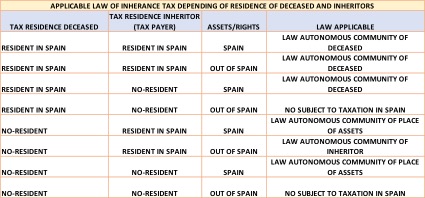
Below, we provide a summary of the applicable legislation in different situations, taking into account the tax residence of the deceased, the heirs and the location of the assets and rights forming part of the estate.
At Welex, we recommend seeking advice from a lawyer specialising in Spanish Inheritance Tax. This will ensure that you are fully informed about all aspects of this tax, as well as the various procedures involved in an inheritance in Spain.
Please do not hesitate to contact us. We will be pleased to assist you.
Related Articles
Am I obliged to accept an inheritance in Spain?
I am a legitimate heir or I have been named as heir in a will, but am I obliged to accept an inheritance in Spain?
Definitive guide for Inheritance Tax in Andalusia
Its a pleasure to explain in the following lines a general summary when it comes to Inheritance Tax in the Autonomous Community of Andalusia (Spain).
Introduction: Who pays inheritance tax in Andalusia, Spain?